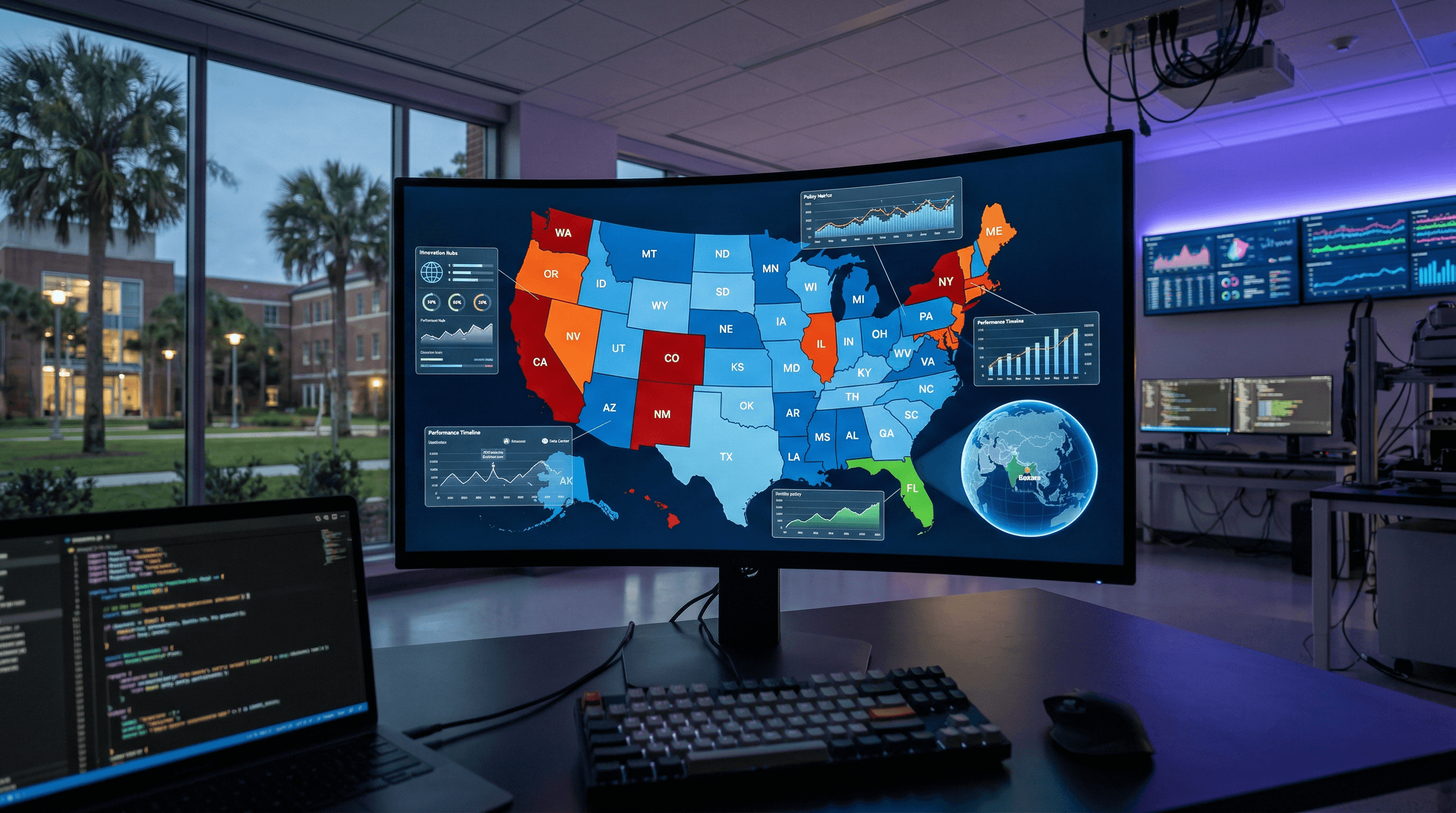
University of Florida students launched an AI regulation dashboard on April 10, 2026. The tool tracks US state-level AI policies. Bangladesh tech hubs gain real-time insights for local adaptation and compliance.
WCJB reported the launch. Students from UF's AI Initiative built it over six months. Developers integrated data from 50 states into one free web platform. This helps BASIS members navigate export rules.
AI Regulation Dashboard Features Boost Global Access
UF students used open-source tools for the dashboard. React powers the frontend. Python scrapes regulatory feeds in real time.
Users view interactive maps of US states. Color codes indicate regulation strictness: red for high-risk areas like California's facial recognition bans, yellow for moderate rules in New York, and green for lighter oversight in Florida.
BASIS, the Bangladesh Association of Software and Information Services, tested it on launch day. BASIS executive director Russell T. Ahmed said, "This tool saves weeks of research time for our 1,200 member firms." Export functions enable CSV downloads. Bangladesh developers adapt US rules to local laws like the Digital Security Act and draft AI guidelines.
Bangladesh Tech Hubs Embrace US Insights
Dhaka's tech parks lead adoption. BASIS members in Mirpur, Gulshan, and Bashundhara City accessed it immediately. They use it to shape Bangladesh's draft national AI policy expected by 2027.
Jessore startups follow suit. Firms in Benapole export software to US clients worth $50 million BDT annually. The dashboard helps them comply with laws like New York's AI bias audits and Texas data privacy rules.
The Bangladesh Computer Council reviewed the tool. Officials noted it aligns with national AI governance goals. Council data shows 15% growth in IT exports to the US last year.
Finance and Crypto Ties for Bangladesh
Crypto markets reacted to AI regulation fears. Alternative.me's Fear & Greed Index hit 16 on April 10, 2026, signaling extreme fear among traders.
Bitcoin rose 1.2% to $72,885 USD. Ethereum climbed 1.9% to $2,242.17 USD. XRP gained 0.4% to $1.36 USD. BNB edged up 0.2% to $606.39 USD. USDT held steady at $1.00 USD.
Bangladesh exchanges like Binance BDT and local platforms monitor these shifts. Jessore traders use mobile apps linked to these assets via bKash wallets. The dashboard flags AI rules impacting trading bots, DeFi platforms, and algorithmic lending.
UF added crypto-specific filters. Bangladesh fintech firms like bKash adapt smart contracts for US compliance. This protects $2 billion BDT in daily mobile transactions.
Technology Stack Enables Real-Time Tracking
Students deployed the dashboard on AWS cloud servers. Machine learning models predict rule changes. Natural language processing (NLP) parses legal texts from state legislatures.
TensorFlow processes state filings with 95% accuracy, per UF tests. Updates run every six hours to capture new bills. The platform handles 10,000 queries daily without lag.
BASIS engineers fixed a latency bug on launch day. Open-source code on GitHub invites global contributions from Dhaka coders. A mobile app launches next month for Android and iOS.
It targets diaspora users, including 500,000 Jessore natives in the UK and US. They advise hometowns on compliance via WhatsApp groups.
Economic Boost for Bangladesh
Garment exporters track US AI automation rules via the dashboard. Bangladesh Garment Manufacturers and Exporters Association (BGMEA) reports 20% factory adoption of AI predictive analytics.
These rules cover supply chain tools and worker monitoring. Compliance avoids $100 million USD in potential fines for 4,000 factories.
Remittances fund tech growth. Bangladesh Bank data shows $22 billion USD inflows for fiscal 2025, with 30% routed to IT startups via bKash.
Venture capital rises sharply. US-Bangladesh AI deals reached $150 million USD in Q1 2026, per Startup Bangladesh Limited. The dashboard cuts compliance costs by 40% and aids investor due diligence.
Broader Impact on Innovation
Khulna tech firms and Jessore University students demoed the tool on April 10, 2026. Professors integrate it into AI curricula for 2,000 students.
The Prime Minister's office cites it in AI strategy briefings. It prevents export bans to US markets, protecting 500,000 IT jobs.
Diaspora networks spread it via LinkedIn groups. UK Bangladeshis in London advise Jessore firms on HIPAA-aligned health AI exports.
UF plans EU AI Act modules by July 2026. Bangladesh developers provide input through BASIS forums.
Path Forward with AI Regulation Dashboard
Bangladesh hosts a BASIS webinar on April 15, 2026, with UF developers. The topic covers adapting US rules to local fintech and garment sectors.
Tech hubs seek $50 million USD for AI compliance funds, per BASIS surveys of 300 firms. Government matching grants could double this.
Crypto recovery signals optimism. Bitcoin holds gains above $72,000 USD. The AI regulation dashboard gives Bangladesh firms a competitive edge in global markets.