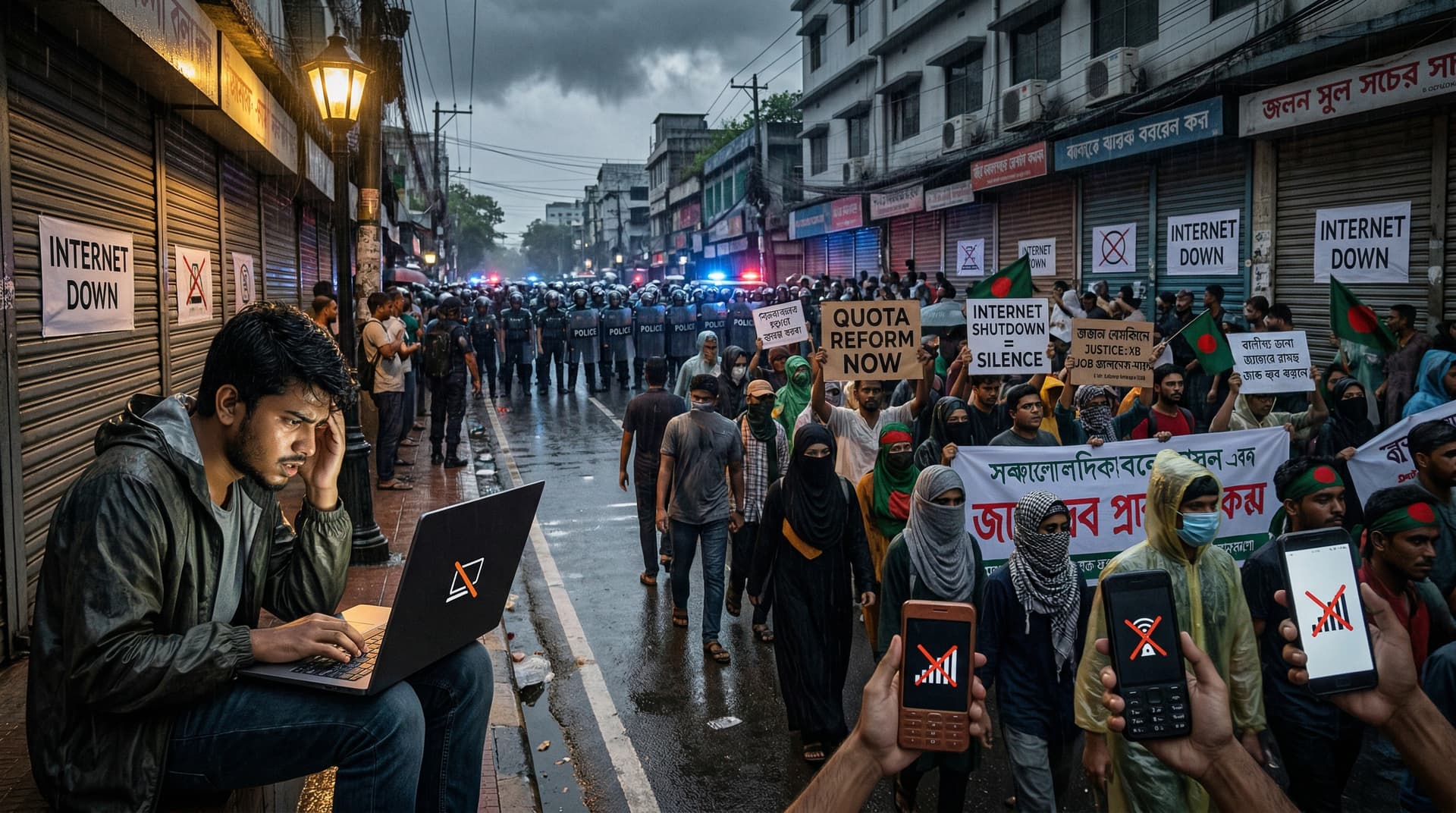
Jessore, July 29, 2024 – In a drastic move to curb escalating violence, the Bangladeshi government ordered a nationwide internet and mobile data shutdown on July 18, 2024. This blackout, now in its second week with partial restrictions lingering, has plunged the country into digital darkness, severely impacting technology-dependent sectors, finance, and everyday life.
Background: Quota Protests Spark Unrest
The trigger for the shutdown was the intensifying student protests against the controversial job quota system, which reserves 30% of government positions for descendants of 1971 liberation war veterans. What began as peaceful demonstrations in early July turned violent after clashes on July 16-17, resulting in over 100 deaths and thousands injured, according to local reports.
Authorities cited the need to prevent 'misinformation' and coordination of violent activities via social media as justification for the blackout. Mobile internet services were completely suspended, followed by fixed broadband throttling. As of July 29, while 2G mobile data has been partially restored in some areas, high-speed 3G/4G and most broadband services remain unreliable or unavailable.
Tech Sector in Crisis
Bangladesh's burgeoning tech ecosystem, valued at over $1 billion in IT exports last year, has ground to a halt. Freelancers on platforms like Upwork and Fiverr – numbering over 650,000 – report zero earnings since the blackout. "We've lost contracts worth millions," said Rafiqul Islam, a Dhaka-based software developer. Remote work, a lifeline for many in Jessore and Khulna divisions, is impossible without stable connectivity.
E-commerce giants like Daraz and Chaldal face massive order backlogs. Online payments via bKash and Nagad, which handle 80% of digital transactions in Bangladesh, are crippled. Reports from the Bangladesh Telecommunication Regulatory Commission (BTRC) indicate a 95% drop in internet traffic.
Startups in fintech and edtech are reeling. Companies like bKash suspended services temporarily, while edtech firms like 10 Minute School canceled live classes, affecting hundreds of thousands of students preparing for exams amid the quota turmoil.
Economic and Financial Fallout
The financial sector is hit hardest. The Dhaka Stock Exchange (DSE) suspended trading on July 22 due to unrest, with the DSEX index plummeting 10% in the preceding days. Online trading platforms are inaccessible, locking out retail investors.
Banks report a surge in cash withdrawals, straining ATMs already limited by power outages in protest-hit areas. The Bangladesh Bank issued directives for manual transaction processing, but digital lending apps and microfinance platforms like BRAC Bank are stalled.
Economists estimate daily losses at $50-100 million. "This is a self-inflicted wound on our digital economy," opined Dr. Ahsan H. Mansur, head of Policy Research Institute of Bangladesh (PRI). The IT sector alone could lose $200 million in July, per BASIS (Bangladesh Association of Software and Information Services).
In Jessore, a hub for garment exports, factories reliant on digital supply chains face delays. Exporters can't file customs documents online via the National Single Window system, exacerbating global shipping bottlenecks.
Social and Humanitarian Impact
Beyond business, the blackout has isolated families. Hospitals struggle with telemedicine, and emergency services rely on patchy radio communication. Social media blackouts have stifled protest organization but also silenced calls for aid.
Human rights groups like Amnesty International condemned the move as a 'digital siege,' violating freedom of expression. NetBlocks, a Turkey-based monitor, confirmed the shutdown as one of the world's most severe in 2024.
Educational institutions remain closed, with universities like Dhaka University epicenters of unrest. Students in regional areas like Jessore report using VPNs via limited broadband, but speeds are throttled to 2G levels.
Government Response and Tech Alternatives
The BTRC claims the shutdown prevented further violence, pointing to reduced arson attacks post-July 21. Prime Minister Sheikh Hasina addressed the nation on July 26, promising quota reforms but defending the measures.
Tech-savvy users have turned to alternatives: satellite internet like Starlink is banned, but smuggled VSAT dishes are popping up in elite areas. Mesh networks and offline apps are gaining traction among activists.
Broadband providers like BTCL and ISPs are under pressure to restore services selectively for 'essential' sectors like banking and aviation. Bangladesh Airline resumed limited flights on July 28 with manual check-ins.
Path Forward: Balancing Security and Digital Rights
As protests simmer, with curfews in Dhaka and Chittagong, the government faces a dilemma. Restoring full internet risks renewed mobilization, but prolonged blackouts threaten economic stability. The World Bank, in a July 25 note, urged 'proportional' restrictions.
For Jessore News 24 readers, the lesson is clear: Bangladesh's digital transformation – from Digital Bangladesh vision in 2009 to 5G trials in 2023 – is fragile. Investments in resilient infrastructure, like decentralized networks, are urgent.
Tech leaders call for dialogue. BASIS President Syed Alawuddin Tuha urged a 'national broadband emergency plan' to safeguard future crises.
This blackout underscores a global trend: governments weaponizing tech during unrest, from Myanmar to Iran. For Bangladesh, July 2024 marks a pivotal test of its digital maturity.
Word count: 912