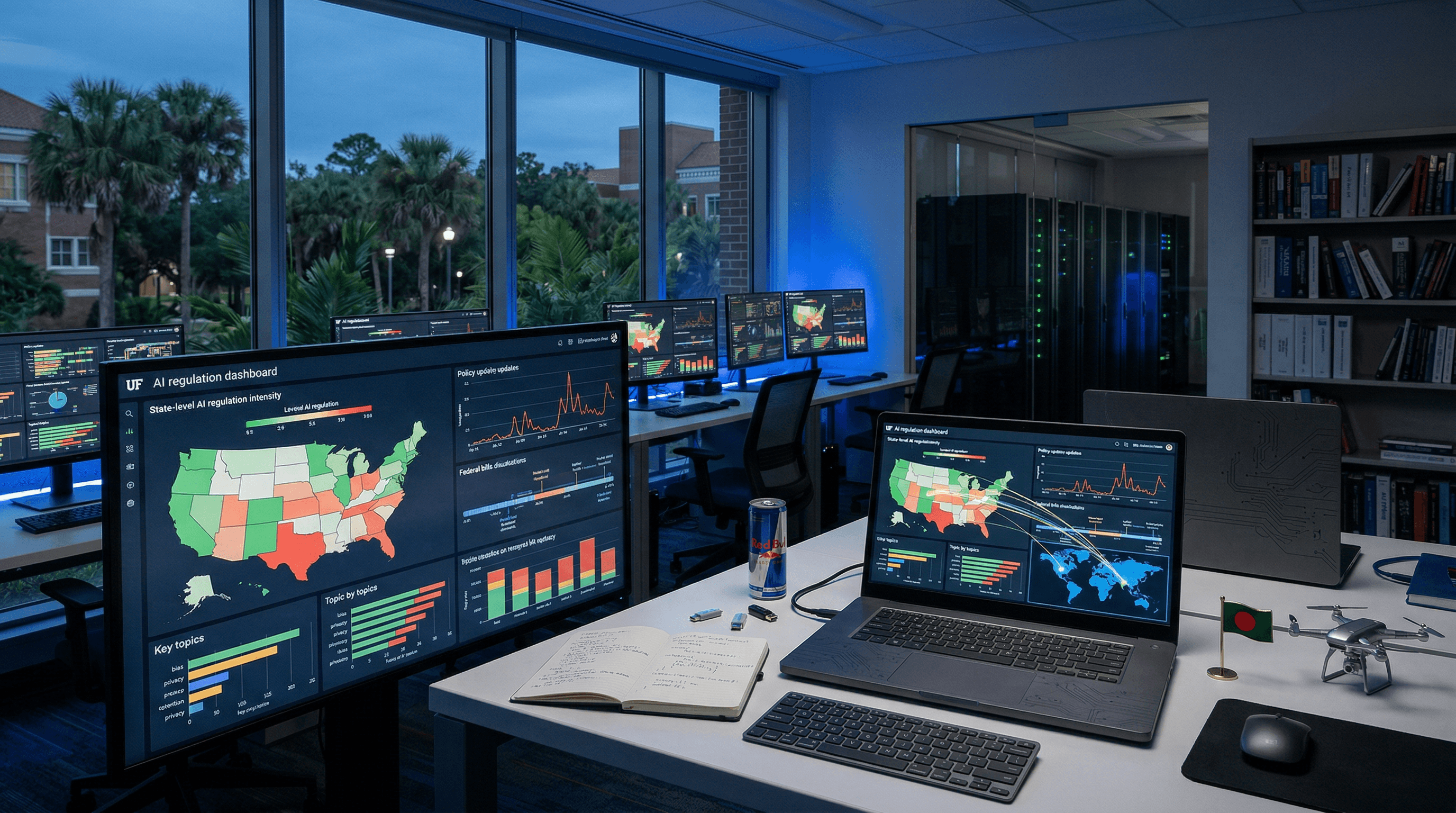
University of Florida students launched an AI regulation dashboard on April 11, 2026. The tool tracks US federal and state AI policies in real time. Bangladesh garment and tech exporters use it for compliance.
WCJB covered the Gainesville launch event. A team of 15 students built the dashboard over six months. Developers aggregate data from government sites and legal databases.
AI Regulation Dashboard Key Features
Users view rules on AI safety, bias mitigation, and data privacy. Filters sort results by state or topic. Real-time alerts notify users of policy changes.
Machine learning models analyze policies daily. Algorithms scan legislative bills and executive orders. Strictness scores rate regulations from 1 to 10.
An interactive map shades states by policy density. California leads with 45 active rules. Texas follows at 32, per dashboard metrics.
APIs enable enterprise integration. A free tier serves startups. Premium access costs $99 USD monthly, student creators confirm.
Surge in US AI Policy Momentum
Federal agencies issued 120 guidelines since January 2026, per NIST data. The White House AI Bill of Rights shapes state actions. Florida enacted three AI laws this year.
UF's Institute for AI Policy directed the project. Professor Elena Vasquez led the 15-student team. Open-source code lives on GitHub for public contributions.
New York mandates audits for high-risk AI systems. Florida regulates AI in education. The dashboard monitors 500 policy updates monthly.
Bangladesh tech firms like Brain Station 23 integrate these insights. BASIS reports they export software services worth $1.2 billion USD annually to the US.
Benefits for Bangladesh Garment and Tech Sectors
Bangladesh Computer Council forecasts 500 million BDT in AI investments by end-2026. Jessore startups deploy AI for agriculture drones and crop monitoring.
Khulna garment factories apply AI for quality control. BGMEA statistics show these plants export 80% of output to the US. US rules require AI transparency in supply chains.
TechNova Bangladesh estimates the AI regulation dashboard cuts compliance research time by 70%. Dhaka developers embed it in export management software.
Diaspora engineers from Jessore remit $2 billion USD yearly, per Bangladesh Bank data. Clear US AI rules spur their investments in homeland tech ventures.
Jessore University exchanges AI ethics datasets with UF via the dashboard. This collaboration strengthens bilateral tech partnerships.
bKash uses similar tracking for fraud detection AI. Nagad explores policy APIs for mobile finance compliance.
Finance Implications of AI Compliance
AI regulations affect tech stocks and cryptocurrencies. Bitcoin traded at $72,743 USD on April 11, up 1.6% per CoinMarketCap. Ethereum hit $2,233.65 USD, rising 2.4%.
Alternative.me's Crypto Fear & Greed Index stood at 15 (Extreme Fear). Stable regulations boost market sentiment. AI-themed stocks climbed 5% last week.
Dhaka Stock Exchange's main index rose 3% amid AI compliance developments. bKash uses AI dashboards to prevent fraud in remittances.
XRP reached $1.35 USD, gaining 0.8%. BNB traded at $606.06 USD, up 1.3%. USDT held steady at $1.00 USD.
Jessore investors see crypto as a hedge against AI regulatory risks. Blockchain firms need such tools. Bangladesh Bank monitors $1 billion USD in annual crypto inflows.
Garment exports generated $45 billion USD last year, BGMEA reports. AI compliance avoids $50,000 USD fines per factory violation.
Global Expansion and Future Roadmap
The EU AI Act sets high standards for exporters. The US AI regulation dashboard fills knowledge gaps. Bangladesh plans its national AI policy by December 2026, ICT Minister announces.
Garment sector AI tools save $200 million USD yearly in efficiencies, BGMEA calculates. Compliance investments yield quick returns.
Students plan EU and Asia expansions. NSF awarded $300,000 USD in grants. Bangladesh leads user requests.
Over 1,000 users signed up in the first hours. Google commended its accessibility. Webinars start April 15.
Bangladesh aims to train 5,000 workers on AI compliance. Jessore IT parks customize the open-source code. Experts predict 15% growth in AI services exports.
Version 2.0 launches in June with machine learning predictions. Bangladesh contributes sector-specific use cases. The AI regulation dashboard positions Jessore as an emerging tech hub.