- Solar drove >25% of 2025 global energy supply growth (IEA).
- Electricity demand rose 3.0% worldwide in 2025 (IEA).
- 20 million EVs sold globally, up 20% (IEA data).
The International Energy Agency (IEA) 2026 Global Energy Review confirms solar overtakes energy sources worldwide. Solar drove more than 25% of 2025 global energy supply growth, surpassing natural gas at 17%, per IEA’s report.
Global energy demand rose 1.3%. Electricity demand surged 3.0%. Renewables and nuclear covered nearly 60% of that growth. Natural gas contributed 17%.
Electric vehicle (EV) sales reached 20 million units, up over 20%. EVs captured 1 in 4 new car sales globally. China's demand growth slowed to 1.7%.
Solar's 25% Lead Reshapes Global Supply
Panel costs fell below $0.20 per watt. Rapid deployment accelerates solar's dominance. Renewables fill gaps from declining fossil fuels. In southwestern Bangladesh's sunny regions, solar now undercuts coal.
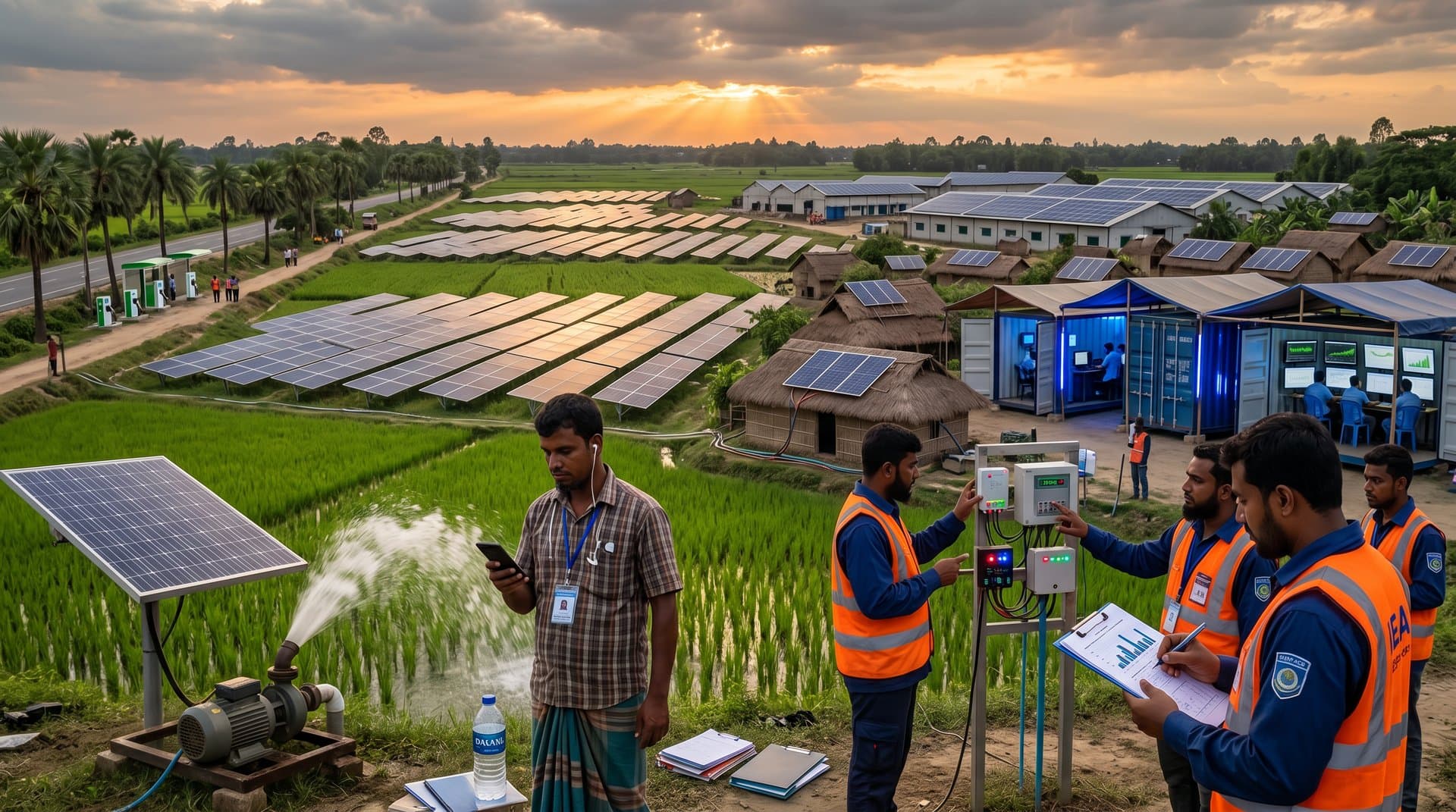
Oil demand grew 0.7%, per IEA data in the Renewables 2025 report. Jessore farmers deploy solar irrigation pumps amid global module oversupply.
- Energy Source: Solar · 2025 Supply Growth Share: >25%
- Energy Source: Natural Gas · 2025 Supply Growth Share: 17%
- Energy Source: Renewables + Nuclear · 2025 Supply Growth Share: ~60% (combined)
- Energy Source: Oil Demand Growth · 2025 Supply Growth Share: 0.7%
Bangladesh Accelerates Rural Electrification
Infrastructure Development Company Limited (IDCOL) delivered over 6 million solar home systems, per IDCOL's 2025 annual report. These systems illuminate remote Jessore villages. Khulna division households swap diesel generators (BDT 200 daily) for BDT 20,000 kits that pay back in two years.
The government aims for 10% renewables by 2030. Solar farms near Benapole port power garment factories. Jessore diaspora in the UK and Jackson Heights remit over BDT 500 crore annually via formal corridors, per Bangladesh Bank data. These funds support local microgrids in upazilas.
bKash, with 70 million users, streamlines solar lease payments. This links mobile finance to clean energy for diaspora families.
AI Optimizes Solar Grids in Bangladesh
Machine learning (ML) models predict solar output hourly using satellite imagery and weather data. Google DeepMind-inspired pilots reduced errors by 30%, according to Rural Electrification Board (REB) trials.
REB installs sensors for real-time balancing. Jessore's 40% off-grid homes gain stable power. AI diverts excess to batteries during peaks.
World Bank loans $500 million for expansion, per World Bank reports. Levelized costs hit $0.03/kWh, far below $1,000 per household grid extension.
Economic Boost as Solar Overtakes Energy Sources
Bangladesh Garment Manufacturers and Exporters Association (BGMEA) reports $50 billion in yearly exports. Solar cuts factory bills by 30%. Jessore hubs like Boyra add rooftop arrays.
Solar pumps irrigate 1 million hectares, per Bangladesh Bureau of Statistics (BBS) agriculture data. Farmers save BDT 10,000 per unit versus diesel at BDT 120/liter.
ADB projects fund $300 million hybrid solar-hydro systems. Bangladesh assembles BYD EVs. Solar stations line the Dhaka-Jessore highway.
Monsoons cut output 50%, but AI pairs solar with hydro. Cheap power attracts Bitcoin mining. BTC trades at $75,200 (CoinGecko, April 2026), market cap $1,506.9 billion, Fear & Greed Index 29. Solar overtakes energy sources, enhancing margins for diaspora investors in Bangladesh's remittance-driven tech ecosystem. Remittance inflows hit $22 billion in FY2025 (Bangladesh Bank), fueling further solar investments.
Frequently Asked Questions
What does it mean that solar overtakes energy sources per IEA?
IEA’s 2026 review states solar drove over 25% of 2025 global supply growth, topping natural gas at 17%. Renewables and nuclear met ~60% of demand.
How does solar overtakes energy sources aid Bangladesh rural electrification?
Cheaper panels under $0.20/W enable IDCOL systems in Jessore. AI grids serve 40% off-grid homes, backed by remittances and bKash.
How does AI support solar overtakes energy sources in Bangladesh?
ML forecasts output with satellite data, cutting errors 30%. REB sensors balance mini-grids toward 10% renewable target by 2030.
What finance opportunities arise as solar overtakes energy sources?
$500M World Bank loans fund projects at $0.03/kWh. Solar attracts crypto mining; BTC at $75,200 eyes gains from cheap power.